

Source: The Listener’s History of Music, volume III. Percy A. Scholes.
Oxford University Press. London: Humphrey Milford. 1930.
_________________________________________
Period VI, The Impressionist School.
(Pages 3-22)
Percy A. Scholes
As Strauss represents a continuation of Wagner, Berlioz, and Liszt, Debussy represents a reaction against them—and a reaction of the most definite and uncompromising character. Never since 1600, when the ‘monodic’ school sprang into existence as a more or less conscious reaction from the ‘polyphonic’ school, has there been such a definite secession from the current ideals, methods, and style. It is worthwhile to recall the essential nature of that earlier secession (fully described in Chapter VI of Volume I), as there are some curious parallels to be noted between these two revolutionary movements, nearly three centuries apart.
Roughly speaking (which is all a book the size of this one can anywhere attempt to do), the chief fundamental technical aim of the 1600 revolutionaries was to present a truly dramatic vocal utterance. The primary principle involved in this aim was, they considered, to make the note express the word, and the emotional flux of the music thus minutely accompany the emotional flux of the text. The chief process was the casting aside of the old-fashioned contrapuntal art, firstly because it took too long to express itself and hence was unsuited for the quick following of the thought of a text, and secondly because its elaborate interweaving and its throwing from voice to voice and ‘development’ of musical themes was too elaborate, too purely and exclusively musical, holding too much of what we may call a pattern-interest to be fitted for close dramatic representation.
The Revolt of Debussy
The revolt of Debussy, and of the few who have to some extent followed him, was not at all unlike that earlier revolt.
Debussy, in his Opera Pelléas and Mélisande, cast aside all purely melodic considerations, all specifically musical expression in the voice parts. He cast aside the contrapuntal and ‘symphonic’ methods of Beethoven and Wagner, because the process of ‘development’ by those methods was too slow a process for an always-on-the-spot and up-to-the-minute reproduction of the shifting emotions to be expressed, and also because these methods, again, savoured too much of pattern-making.
Debussy on Bach and Wagner
Debussy received the normal training of a great school of music. He was acquainted with the Classics and the Romantics. He studied counterpoint in the usual way, though without much enthusiasm. He visited Bayreuth and was impressed. Then he turned against the Classics (or at all events against Beethoven) and against the Romantics, and, particularly, against the Master of Bayreuth. With all the fervour of a convert he exclaimed, ‘Bach is the Grail and Wagner is the Klingsor, trying to crush the Grail and to take its place’. This praise of Bach may seem inconsistent with the allusion that has just been made to the essentially uncontrapuntal style of Debussy. And, indeed, to describe without apparent inconsistencies the position of Debussy (or, for that matter, of any composer who theorizes about his art) is difficult. What Debussy liked in Bach may be grasped from the following discussion by him of a Bach Concerto—
Here we find almost intact that style of musical ‘arabesque’, or rather ‘ornamental principle’, which is the base of every mode of art. The Primitives, Palestrina, Vittoria, Orlando di Lasso, and others, made use of the divine arabesque. They found the principle of it in the Gregorian chant, and supported its frail threads by means of opposing counterpoints. … Do not even begin to think there must be something unnatural or artificial in this. On the contrary, it is infinitely more ‘true’ than the poor little cries that the lyric drama seeks to produce.
Of course you may remark that you never heard anybody whistle Bach. This mouth-glory Wagner has achieved; on the boulevard at that moment of the day when the prisoners-de-luxe of the musical houses of detention are released you may hear gaily whistled the Spring Song of The Valkyrie, or the opening phrase of The Mastersingers. I know that lots of people think that this is music’s promised reward, but may one not claim to hold the contrary opinion without being thought singular?
Apparently, then, it was the decorative quality of the melodic element in Bach (rather than the masterly counterpoint) that appealed to Debussy, and indeed there is, questions of tonality aside, an obvious plain song or Bach-like arabesque quality about many of Debussy’s own themes.
Here is a Flute theme from The Afternoon of a Faun.
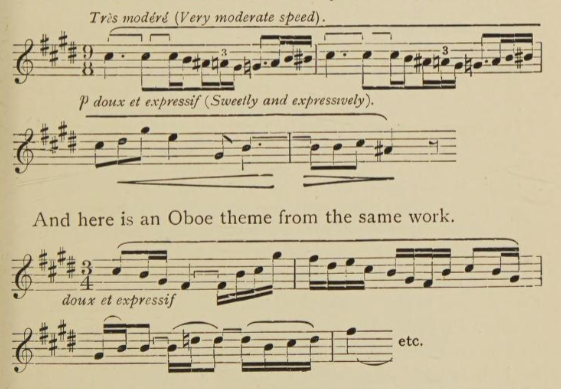
And doubtless Bach’s reticence also appealed to him. Bach could express awe or jollity as well as any one, but he never expresses unrestrained romantic passion. We cannot imagine anything equivalent to the erotic transports of Siegmund and Sieglinde or Tristan and Isolda as coming from Bach—or, for that matter, Handel or Mozart or any composer of the eighteenth century. (1)
Anti-Romanticism
And Debussy loved the eighteenth century. When a composer or poet takes a dislike to a century (and many do!) it is always to that which immediately precedes his own. The century before that he praises. So Debussy objected to the Romantic Movement in music (including Beethoven, its great herald, but not including Chopin, whose Gallic grace and arabesque-like melodic shapes attracted him) and lauded the ‘classical’ period, including Mozart and Bach and especially Bach’s French contemporaries, Couperin and Rameau, in whom, again, he admired simple ‘rightness ’ and reticence—
We possess a pure French tradition in the work of Rameau, with its delicate and charming tenderness, its rightly placed accent, its rigorous declamation, its lack of pretense to a German profundity and of a need to emphasize with blows of the fist, to explain breathlessly, which seems as though one were for ever exclaiming ‘You are a collection of idiots who understand nothing unless one compels you by force of exaggeration’. It is to be regretted that for so long French music should have taken a road that has led it far from that clarity of expression, that precision and terseness of form that are the particular and significant qualities of the national genius.
In the allusion to ‘German profundity’ and ‘blows of the fist’ we see, of course, hints of the distaste for Beethoven and Wagner in particular, and in Debussy’s own music we find that in the revulsion from the forcefulness of these composers he has, indeed, often shown himself a master of that most telling forensic art of understatement.
(1) W. McN. interjects, ‘Why on the side of non-reticence instance only romantic passion and eroticism? The non-reticence extends to all strong feelings: Hate (Alberich), Physical Exaltation (Forging Songs), Loyalty (Kurvenal), Pain (Amfortas), Friendship (Sachs and Walther), &c.’
The Influence of Musorgsky
Debussy’s armour against Germany came largely from Russia, his armour against Wagner from Musorgsky. The un-Wagnerian directness of Musorgsky appealed to Debussy—
Nobody has ever spoken of all that is best in us with an accent more tender or more profound; he is unique and will remain so, with his art devoid of system and of dry formulae. Never has so refined a sensibility been translated by means so simple. His music is like that of some enquiring savage discovering music step by step as his emotions develop. There is no question of any particular form, or at any rate what form there is is so many-sided that it cannot be related to the established (or as one might say, administrative) forms; the music is made up of little successive touches, bound together by a mysterious connection, and by a gift of luminous clairvoyance; sometimes, too, Musorgsky gives a sensation of trembling and unquiet shadows, which wrap themselves around the heart and press upon it to the point of anguish.
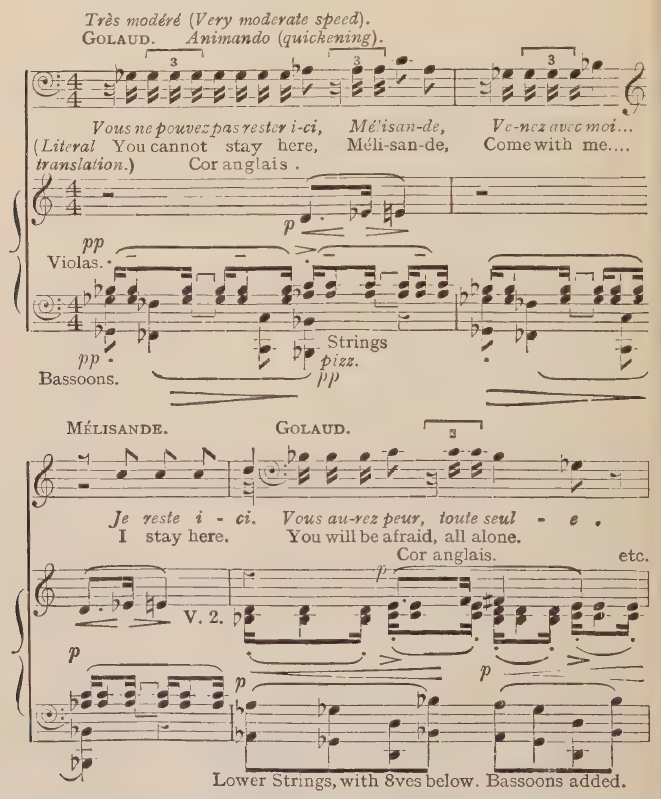
In Debussy’s music any kinship with Musorgsky is, perhaps, not very obvious. It is particularly hard to find in Debussy directness and primitiveness, at any rate of the Russian brands. It is almost impossible to find in him any of Musorgsky’s simple, elemental force. For Russian or Musorgskyan feeling we should, in fact, have to search a long time; but Musorgsky’s influence in dramatic method, and above all the parallel of Debussy and the 1600 revolution, s to be seen in the songs, and in the Opera Pelléas and Mélisande, the music of which is so glove-like a fit to the words that the work might almost be called one long recitative. For example, in the first scene Golaud finds Mélisande in the gloomy forest. Golaud tells Mélisande who he is, she tells him her name, and he persuades her to follow him to the Castle. Yet with none of this are we given so much as the beginning of a set song. (Compare the telling duet of Puccini’s Mimi and Rudolf when they first meet in Act I of La Bohème). In the whole Scene there is no nearer approach to ordinary ‘melody’ than this:
So far we have seen in our study of Debussy three influences, (a) a reaction against the fervour and complexity of the whole ‘Romantic’ school as it then existed, (b) a corresponding love of eighteenth-century concision and clarity, and (c) an equally corresponding love of dramatic directness, such as that found in Musorgsky. We now come to some definite influences emanating from sister arts.
The Literary Symbolists
The ‘Symbolist’ Movement in poetry and the ‘Impressionist’ Movement in painting were at their height when Debussy, returning in 1887 from study in Rome, settled again in Paris. Baudelaire, the chief precursor of the Symbolist Movement, was dead twenty years before, but Verlaine was alive, as also Mallarmé and a group of younger poets who gathered at. Mallarmé’s house and looked to him as their leader. Debussy frequented this house and imbibed the ideas there current, so it is of interest to us to get as clear a notion as possible of the nature of those ideas.
To describe in a few words the Symbolist Movement in literature is not easy. On its negative side it was a reaction against the big-bow-wow style of the French Romantic poets, and especially of the latest group of them who were known as the ‘Parnasseans’. The Symbolists attempted a product altogether more delicate. To an English reader the change of feeling and method from Byron to Rossetti may convey a rough-and-ready idea of the change of feeling from (say) Hugo to Verlaine. And, too, as to ‘content’ the comparison between Ruskin and Pater may help. Ruskin was the apostle of what has been called ‘moralized beauty’—a sort of Christian-statesman-critic. Pater was aesthetic and a frank hedonist— not the fruit of experience but experience itself is the end. ‘A counted number of pulses only is given to us of a variegated and dramatic life. How may we see in them all that is to be seen in them by the finest senses?’ (1)
(1) From the conclusion of Pater’s Renaissance. He omitted it from the second and third editions, as he ‘conceived that it might possibly corrupt some young men into whose hands it might fall’. In the fourth edition, somehow reassured—or grown reckless, he restored it.
The Impressionist School
There was, then, a good deal of the sensuous and the voluptuous about the Symbolist group, but they were a delicate sensuousness and a refined voluptuousness, expressing themselves with an aristocratic grace.
Nothing was coarsely or bluntly expressed. Indeed, what a poem said was almost less important than what the reader was led to think between the lines. There was a constant stimulus to the imagination, and herein lies the force of the title the Movement adopted. Words were used as symbols. They suggested rather than expressed.
This often led to obscurity, and in some cases obscurity actually seemed to be the object. Nobody has ever yet been able to translate into plain English Mallarmé’s L’après-midi d’un faune, and probably nobody ever will succeed either in translating it adequately into any language or in rendering a satisfactory prose paraphrase.
Poetry like this approaches the quality of music. More than any other art, music (at its best) is the art of the subconscious. Try to find words with which to express the changing emotional shades of a Chopin nocturne, phrase by phrase of the music, and you will soon realize that in ‘appreciating’ that nocturne, as you have done perhaps hundreds of times, you have been subconsciously following a play of emotional expression that you cannot with any completeness or exactitude consciously re-express.
This musical attribute was deliberately sought by the Symbolists in their poetry. Baudelaire had, in his time, counselled that poets should ‘take possession again of their lost estate in the realm of music’ (‘reprendre à la musique leur bien’). Paul Valéry, writing about the Mallarmé group, said, ‘Music had been our very food, and our literary minds dreamt of nothing but to draw from language almost the same effects that sonorities produced on our nervous system’.
This, then, may be looked upon as a movement in literature the very opposite of the programme-music movement in music.
The Literary Symbolists
As in programme-music the composer borrows and tries to re-express more or less definite literary ideas, so in Symbolist poetry the poet tries to achieve expression of emotion denuded, to the limits of possibility, of definite literary ideas. Mallarmé said, ‘To name an object is to sacrifice three-quarters of that enjoyment of the poem which comes from the pleasure of guessing bit by bit. To suggest it—that is our dream.’ (1)
The reader who is pretty well acquainted with even three or four of Debussy’s compositions but has not previously grasped the connexion between his style and the aims of the Symbolist poets must surely now see a little light. The Symbolists were attempting a poetry like music, and Debussy, inspired by them, attempted a music more musical than had previously (or, at any rate, recently) been written, in that it eschewed, as far as possible, those Beethoven-like or Wagner-like complexities of development of theme which resemble argument or rhetoric, those Lisztian emotional passages that can easily be re-expressed in words, and those detailed ‘programmatic’ attempts which belong most properly to the short story or novel.” (2)
The Painter Impressionists
So much for the Poet-Symbolists; now as to the Painter-Impressionists, a closely allied group. Their aims differed from those of the Symbolists, one may say, merely as the art of painting differs from the art of poetry. Sir Edmund Gosse has said of the Symbolist poets that their verse was ‘a murmur of waters flowing under a veil of rushes’, and we may say of the Impressionist artists that their painting was a play of light. They shunned drama (‘Light is the chief personage in a picture’ was one of Manet’s maxims), ‘literary’ subjects, classical formality and all established conventions, and sought to make out of the representation of effects of luminosity a kind of beautifully painted music. A technical procedure which is of interest, because in a moment we shall find a slight musical analogy to it, is the process of painting in pure, unmixed colours in such a close juxtaposition that at the proper distance the eye sees them merged into their intended composite. Like the poets they tried to achieve delicacy of nuance; as an example, they discovered that shadows are not necessarily black, but have their varying colours.
(1) It seems to us to-day rather strange that Mallarmé and his colleagues were at one period enthusiasts for the romantic Wagner. Presumably the mythology, with its suggestions of mysterious forces of nature behind the happenings of life, was what attracted them.
(2) Debussy certainly wrote a good deal of music that can be called ‘Programme Music’ (The Cathedral under the Sea, Minstrels, Evening in Granada, The Wind across the Plain, &c.). But in it all the musical condition is paramount, and though stories can legitimately be read into some of the pieces it is easy enough to see that their passages were not modelled upon any definite scheme of ‘events’. It is, then, only ‘Programme Music’ in the more general sense of the term.
Manet may be considered the founder of the School, other members being Monet, Degas, Renoir, Pissarro, Sisley, and Cézanne.
At first the Impressionist painters had no popular success. They got their name as a nickname, from a painting of Monet’s, Sunrise, an Impression, at the historic ‘Salon des Refusés’ of 1863; the idea of the term is that the painter records what a quick glance can see, i.e. he does not unnaturally assemble in one picture a mass of details each of which could only have been observed by its own particular glance. The pictures of this exhibition were sold by auction at the end and fetched an average of four pounds apiece. Later, to help Monet who was in poverty, Manet, who was well-to-do, with a friend of his, anonymously bought ten of his pictures for forty pounds. (1)
(1) In 1923, Monet, aged 83, visited Paris to see, with his old friend Clemenceau, the building at the Tuileries that had been prepared to house nineteen of his paintings which a grateful nation had accepted as a gift from him. So does time bring its triumphs!
‘Impressionism’ in Tone
The comparison between the Impressionist painting and Debussy’s music is quickly made. Debussy, too, as has already been said, avoided the dramatic, the narrative, the formal, the conventional, the involved. The preoccupation of the Impressionist painters with light quâ light had its parallel with this Impressionist musician in a preoccupation with tone quâ tone.
To take an example, frequently his chords are separate entities, their notes chosen and spaced on the piano (or distributed in the orchestra) in such a way as to produce the desired momentary tonal effect, and with little or no regard to their neighbours in such matters as the ‘preparation’ or ‘resolution’ of discords.
For the most part the harmony of Strauss is an extension of that of Wagner, whose harmony is an extension of that of Beethoven, whose harmony is an extension of that of Haydn. But Debussy’s harmonies very frequently indeed can be derived from nothing heard from previous composers. Gifted with a very keen ear, he had listened to bugles and particularly bells, and had studied the ‘overtones’, the components of what we wrongly term a single note—those overtones the particular character and relative strengths of which, in any particular performance of a note, give that note its ‘timbre’. And often he reinforced some of those overtones by the addition of notes, and so arrived at tonal effects by a synthetic process somewhat similar to the technical process of the Impressionist painters above referred to.
An influence in encouraging Debussy’s freer conception of harmony was the music of his contemporary, Erik Satie, to be briefly discussed later in this volume.
Like the Poet-Symbolists and the Painter-Impressionists, Debussy is generally very ‘atmospheric’, and so, like them, he has been charged with vagueness. There is abundant design in a picture of Monet or a composition of Debussy, but (to quote The Times obituary notice of Monet in 1926, for the sake of its interesting allusion to Debussy)—
It stands to reason that if an artist is designing in atmospheric values, in veils of light, the design will not be so emphatic, so easily grasped as if he were designing in solid forms, but nobody can look with attention at a picture by Monet and regard it as a mere representation of the facts and conditions. In this respect his work might well be compared to the music of his countryman, Claude Debussy, in which, under an atmospheric shimmer, the melodies are not so immediately recognisable as they are in the works of Bach and Beethoven, but are nevertheless present to an attentive ear.
The Whole-Tone Scale.
A special technical device of Debussy to which allusion is often made is his use of the whole-tone scale.
There are two pitches at which this scale is available. It will be seen that, with enharmonic changes (reading F sharp = G flat in (a), C flat = B in (b), and so on), there is no note in our musical system which cannot be found in one of these two pitches of the scale.
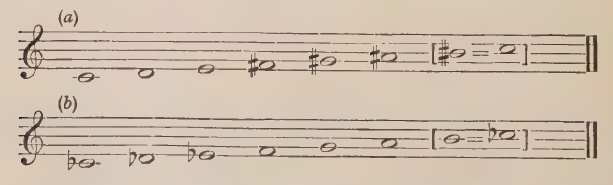
This scale is necessarily the most fluid possible. As all the intervals are the same, it may- be said to have no features. Its effect, then, is vague, and so it contributes to the ‘atmospheric’ or ‘remote’ effect that is characteristic of Debussy. (1)
(1) E. W. recalls his foot-note to vol. i, p. 35, and says, ‘I myself always seem to feel this whole-tone business not as a scale but as a chord (in arpeggio or in harmonic blocks).’
Debussy was not the inventor of this scale, but he made more systematic use of it than had any one before him. Here are two typical examples of his use of it. The first is from Bells sounding through the leaves (Cloches à travers les feuilles) from the Second Book of Images for Piano Solo. We have a whole-tone-scale melody at the top, supported by harmony which is just made to fit the melody. (Notice the complete descending whole-tone scale at the outset; there appears to the eye to be a gap between the first two notes— such notation will generally be found necessary in practice.)
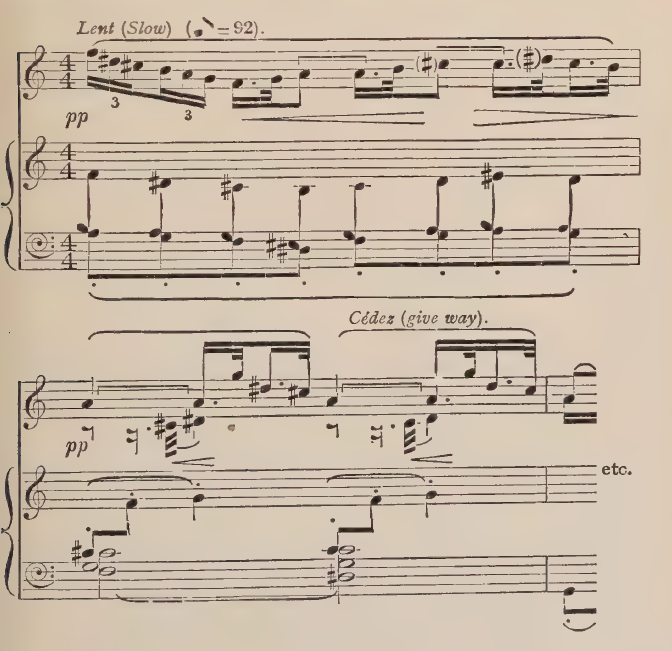
Two other points are illustrated in this example; firstly, Debussy’s interest in bells, which we have just noted, secondly, his use of chords simply as blocks of sound, as shown in the lower part in the first bar. Debussy was really the inventor of this typical modern practice.
In our second illustration, we have a few bars, from The Afternoon of a Faun (L’apres-midi d’un faune), of purely diatonic melody, with whole-tone chords arbitrarily introduced into the accompaniment at the second and fourth bars.
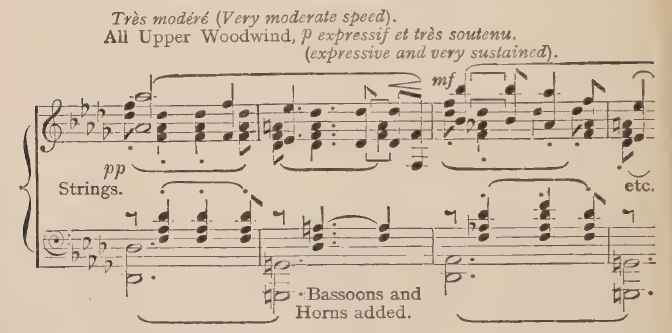
Debussy’s Subjects.
The subjects Debussy has chosen for his composition are, in the main, just what one would expect, given his style. It is a style with limitations. No ‘Fate knocking at the door’ symphony, no ‘Hero’s Life’ tone-poem, could be achieved by Debussyan methods, even if such subjects were in consonance with the composer’s general trend of mind. (1) The mystical Maeterlinck symbolist play, Pelléas and Mélisande, is a natural choice as the subject of an opera; his style suits it perfectly. The opera is a masterpiece that can never be repeated, for the combination of librettist and composer will assuredly never occur again.
(1) E. W. protests, ‘Beethoven is no doubt reported to have said that the first four notes of the C minor Symphony represented Fate knocking at the door; he is on equal authority reported to have said that they represented the note of some bird or other—but the latter interpretation is usually forgotten! I imagine that more pseudo-emotional nonsense has been written about the “‘fate-meaning ” of this Symphony than about any other imaginary “meaning ”—which is saying a good deal. The Hero’s Life interpretation being definitely, even anxiously, authenticated in all its details isn’t pari passu, is it?’
Mallarmé’s Afternoon of a Faun is another obvious choice as the subject for an orchestral piece, and its immer haze and heat are wonderfully suggested. It is very interesting to recall that Manet illustrated the first edition of his poem, so that we have here a concentration upon one and the same subject of the efforts of a leading Symbolist poet, a leading Impressionist painter, and the leading Symbolist-impressionist composer. (1)
(1) It is terrible to imagine what things the realist Strauss would have done had he attempted a tone-poem on that subject. What an afternoon that Faun would have had!
Clouds and The Sea are other orchestral examples of nature ‘impressions’, and amongst the piano pieces are Gardens in the Rain, Reflections in the Water, Goldfish, Mists, Dead Leaves, and many others.
There is in everything Debussy has written a suggestion of aristocratic refinement. The Symbolists and Impressionists were a sort of aristocracy. Mallarmé scorned the crowd and administered the duties of a sort of esoteric priesthood. There was a certain superiority about all these subtle practitioners of the three arts and perhaps they loved art rather than humanity. This apt remark has been made about Debussy’s music—‘It is lonely music; there are no people in it.’
Properly considered Impressionism is a Phase of Romanticism, but it is Romanticism become reticent, or at least more nonpersonal. The heart is there, but it is no longer worn on the sleeve.
NOTE
Of late, particularly in France, protests have been made against the labelling of Debussy as an Impressionist Composer.
Such protests seem to be based mainly upon the idea that by the plication of the word ‘Impressionist’ there is implied something derogatory to Debussy as a master of musical form. Those who make the objection appear to believe that Impressionist painting is formless; this matter is put upon the right footing in the quotation from The Times above given, and nothing need be added to that.
Another idea seems to be that the word ‘Impressionist’ as applied to Debussy suggests that he was a painter of musical landscapes, whereas it is rather the emotional suggestions of a landscape that he conveys. This second objection seems to be really stupid, since apart from the fact that to paint a landscape in sounds is an impossibility, it is Debussy’s very skill in conveying the emotional suggestion of a scene of nature that is so marked, and that most entitles him to the description ‘Impressionist ’. (1)
It is amazing that any one should cavil at one of the aptest labels ever yet attached to the baggage of any composer as it started its travels down the ages, and the objections are only alluded to here so that it may not be thought that this chapter has been written in ignorance of them. As has been shown in this chapter, an approach to parallelism between Debussy’s music and the poetry of the Symbolists and the painting of the Impressionists is clearly defined, and the personal relations between Debussy and the Symbolist poets and Impressionist painters were close.
(1) In any case, the critic Debussy, introducing his mythical character of Mr. Quaver (Monsieur Croche), into whose mouth he was accustomed to put his own opinions, was able to say of him, ‘that he spoke of a score as if he were speaking of a picture, hardly ever using technical terms’, so that the parallel between Debussy’s art and that of a certain school of painters would not be entirely repudiated by the composer himself.
The Art of Ravel
Having discussed at some length the nature of Debussy’s contribution to the art of music, it is comparatively easy, by defining differences, to discuss that of Ravel. Yet if this handy method be adopted, with it must go the warning that Ravel is no mere secondary Debussy and no mere disciple. Ravel is discussed second on purely chronological grounds, and described relatively on grounds of convenience.
Debussy and Ravel are both ‘Impressionists ’, but Ravel is less truly so than Debussy, inasmuch as his music is less ‘misty’ or ‘atmospheric’. Put Franck and d’Indy on one side and Debussy and Ravel on the other and you seem to have two distinct styles; then take Franck and d’Indy out of the discussion altogether and look only at Debussy and Ravel, and their distinction of style becomes clear enough. (Put red on one side and various blues on the other and you have an evident contrast; put red out of sight and your various shades of blue begin to sort themselves into classifications of their own.)
Debussy and Ravel—a Comparison
Comparing any sufficiently large body of mature work of the two composers, it will be realized that Debussy’s is more ‘fluid’ and Ravel’s somewhat more ‘solid’, i.e. more firm and clear in its outlines. Or Debussy’s work is rather more ‘subjective’ and Ravel’s more ‘objective’. Partly this shows itself in differences of harmonic idiom. A good way of realizing the ifference would be to hear, on consecutive evenings, Debussy’s Opera, Pelléas and Mélisande, and Ravel’s Opera, L’Heure Espagnole. It would then be found that Debussy was much more occupied in evoking emotional ‘atmosphere’, and Ravel in musically characterizing the sense of words which expressed clear thoughts or described dramatic ‘events’. To this the rejoinder may be made that the literary subjects are very different and call for widely differing treatment, but to that lay be re-rejoined that nobody imposed these subjects upon ne respective composers, and that their very choice of them emphasizes the psychological difference between the two men.
The Italian composer, Casella, has drawn a fairly apt parallel by suggesting that as Schumann stands to Mendelssohn in German Romanticism, so does Debussy stand to Ravel in French Impressionism.
One great distinction between Franck on the one hand and Debussy-Ravel on the other is that the Franck music is charged with Christian feeling (mystical Christian feeling, that is), whereas the Debussy-Ravel music is an expression of Paganism. Analysing further, Debussy represents the more shadowy side of Paganism (take The Afternoon of a Faun as an example) and Ravel the more clean-cut type of Pagan mythology (take Daphnis and Chloe as an example).
Both composers were opposed to the ‘big’ ideas of the Beethoven-Brahms school, both were careful manipulators of scraps of detail, but Ravel is a little more concerned with the planning and arrangement of his detail. To use the cant phrase, he is a trifle more ‘cerebral’; he keeps command over himself and plans very exactly, and he tends to observe rather more closely than Debussy the principles of classical musical form.
Somebody has compared Ravel as a composer with Poe as a poet—Poe who maintained that there was no ‘chance’ in art any more than in mechanics, and that a poet’s ‘happy find’ is as much the consequence of a train of reasoning as an engineer’s ‘invention’. When Poe wrote his famous essay on The Philosophy of Composition he was ignorant of what a more modern psychology has revealed to us of the workings and relations of the conscious and subconscious mind. It is now clear to us that one poet may depend much more than another on (conscious) reasoning and less on (subconscious) ‘intuition’, which is, after all, probably only a concealed reasoning; and so, in musical composition, Ravel seems to depend more upon the conscious than Debussy, and as a consequence the workings of his mind are seen by us in a whiter light. Debussy’s music seems to ‘grow’ like an organism where Ravel’s is more worked out to a scheme. Another Italian composer-critic, Pizzetti, has said that Ravel interests the listener’s intelligence rather more than it interests his heart, and that is, perhaps, the same thought expressed in another way.
It seems strange to any one who knows the ‘indolent voluptuous Massenet’ to be told that he influenced Debussy, yet we have Debussy’s word for this, and going back to his earlier works can find confirmation. Ravel, on the other hand, was more influenced by the colder, less sensuous style of the classically-minded Saint-Saëns.
Debussy’s frequent use of the essentially vague ‘whole-tone’ cale has been mentioned; Ravel uses it practically not at all. This is typical.
Both Debussy and Ravel are ironists—especially Ravel. They both look on at life rather than throw themselves into it, and somewhat lack the large sense of humanity, of fraternity.
Like Debussy, Ravel is a great inventor of novel ‘effects’. From Playing Fountains (Jeux d’eau) onwards his additions to the stock-in-trade of the piano composer have been frequent and valuable. In orchestration he is equally original. Mr. Roland-Manuel has said that of all beings Ravel and Stravinsky best know the weight of a soft trombone chord, a ’cello harmonic, a pianissimo touch of the Tam-tam in relation with such-and-such an orchestral grouping. He makes a distinction between Debussy and Ravel as to orchestration which confirms ‘om another side all that has just been said as to the difference between temperaments and methods—Ravel’s music is fairly easy to conduct; follow the composer’s directions and his effects are produced: Debussy’s music is very difficult to conduct; the securing of the effects is a matter of extremest delicacy and requires enormous ability, and even the possessor f such ability seems to be somewhat in the hands of ‘luck’, succeeding on one occasion and, with the same orchestra in the same room, failing on another.
Like Debussy, Ravel is a harmonic innovator. Both men use parallel thirds, fourths, fifths, &c., very freely, but Debussy inclines more to the use of parallel ninths than Ravel, who ours parallel sevenths.
No composer has gone further than Ravel in the suggestion of economy—in giving the impression that every note of his music is essential.
As to literary influences, Ravel (despite what has just been said about his Opera) has accepted much the same as Debussy, with a slightly greater appreciation of some less definitely ‘impressionistic’ and ‘symbolist’ poets. He has compositions based upon Mallarmé, Verlaine, Verhaeren, Henri de Regnier, Jules Renard, Tristan Klingsor, Franc Nohain, and others, but he has also felt the value of some poetic inspiration of the past—Marot, Perrault, Mme. d’Aulnoy, and the Princesse de Beaumont.
[ … ]