

Abstract
Introduction. The ‘Emergent Zone’ is a boundary space where humans and AI co-construct meaning, authorship, and responsibility in response to the transformative impact of conversational information retrieval systems.
Method. Develop a conceptual framework by synthesising the information foraging theory, Vygotsky’s Zone of Proximal Development (ZPD), and Kuhlthau’s Zones of Intervention, all grounded in LIS literature and expanded through critical AI perspectives.
Analysis. AI’s roles as forager, scaffolder, and intervener are illustrated by illustrative exemplum cases from library references, disinformation detection, and learning environments, revealing both efficiencies and profound challenges to agency and accountability.
Results. The framework underscores the urgent need for new critical literacies (e.g., prompt, interpretive, algorithmic, and ethical) and positions meta-literacy as an integrative foundation for LIS.
Conclusion. The Emergent Zone advances scholarship on AI–human interaction, calling for new literacies and reimagined pedagogies and ethics in LIS, and proposes future research emphasising justice-oriented and cross-cultural approaches.
Source: Information Research – Vol. 31 No. iConf (2026). DOI: https://doi.org/10.47989/ir31iConf64250.
License: Copyright (c) 2026 Anika Meyer, Marlene Holmner, and Theo JD. Bothma. This work is licensed under a Creative Commons Attribution-NonCommercial 4.0 International License.
__________________________________
Redefining critical literacies and ethics in human–machine conversations in the emergent AI-human zone
Anika Meyer, Marlene A. Holmner, and Theo JD. Bothma
Introduction
Artificial intelligence (AI) increasingly shapes how people search, filter, and use information across domains like education, healthcare, and governance. Conversational information retrieval (CIR) systems through generative AI (GenAI) tools such as ChatGPT illustrate a shift from static tools to dynamic, collaborative dialogue agents (Adelakun, 2024; Agrawal, 2025). GenAI tools, powered by large language models (LLMs), ‘use a large data set to create something in the genre of that dataset’ (i.e., text, images, videos, etc.). ‘LLMs use deep learning and neural networks to train on large text corpora for recognising and generating texts based on probabilistic patterns’ (Håkansson & Phillips-Wren, 2024, p. 5458). Thus, LLMs are a type of GenAI that explicitly focuses on generating human-quality text.
GenAI systems are unlike traditional IR databases; they interpret user intent and anticipate follow-up needs through iterative dialogue (Agrawal, 2025). This paradigmatic shift necessitates new frameworks that move beyond models of the solitary user, like those of Wilson (1999), Kuhlthau (1991) and Ellis (1989), to properly account for symbiotic, human-AI collaboration (Shah & White, 2025). Agrawal (2025) states that ‘transforming digital search into a conversational experience represents a fundamental reconceptualisation of how humans interact with information systems’. Therefore, frameworks and models should illustrate AI’s new roles in filtering and scaffolding, which results in the boundary between user and system blurring into a hybrid cognitive space.
This paper introduces the ‘Emergent Zone’, a dynamic, interactive boundary where humans and AI co-create meaning, negotiate agency, and redefine literacy through conversations to address this paradigm shift. The framework draws on Pirolli and Card’s (1999) information foraging theory, Vygotsky’s (1978) Zone of Proximal Development (ZPD), and Kuhlthau’s (1994) Zones of Intervention, extended through LIS applications (Fourie, 2013; Roy & Mukhopadhyay, 2023). It is further refined through the lenses of critical data studies (D’Ignazio & Klein, 2020) and intercultural information ethics (Capurro, 2008).
Global frameworks, such as UNESCO’s (2021) Recommendation on the Ethics of AI, underscore the urgency of responsible implementation. In the Global South, the stakes include persistent digital divides and the potential for AI to either empower or further marginalise communities (Czerniewicz, 2018; Panteli et al., 2025).
The central argument is that the Emergent Zone requires new literacies: prompt literacy, interpretive vigilance, algorithmic awareness, data literacy, and ethical reasoning. For LIS professionals, this implies rethinking pedagogy and professional ethics; researchers demand methods sensitive to human-AI entanglements (Łabędzki et al., 2025). This paper explores these challenges, offering illustrative exemplum cases as a roadmap for navigating this new terrain and suggesting a conceptual framework based on literature findings. This paper will use the term ‘AI’ to refer to both traditional AI and GenAI.
Theoretical background
Information foraging theory (Pirolli & Card, 1999) is based on the idea that people (similar to animals hunting for food) search for and consume information on the web to maximise benefit and minimise effort. The more useful cues (information scent) the user picks up to fulfil their information need, the more likely they will continue on this information seeking path. With GenAI tools, systems appear to forage by probabilistically generating responses from learned patterns, sometimes augmented by retrieved context, creating the impression of aggregation and synthesis for users rather than directly retrieving or ranking documents (Park, 2025). However, this curation highlights risks of bias and exclusion, given proprietary training data, optimisation objectives, and platform incentives (O’Neil, 2016; Pasquale, 2015). The theory must be updated to account for the AI-driven foraging, redefining ‘information scent’ by replacing traditional cues with AI conversational recommendations and summaries.
Vygotsky’s (1978) ZPD positions learning as socially mediated and supported by scaffolding (Fourie, 2013). AI CIR scaffold responses by proposing synonyms and controlled vocabulary, drafting search trings through natural language conversations, or offering stepwise guidance when conceptualising topics. AI can function as both peer and mentor, scaling help while risking dependency and the erosion of visible authorship. This introduces a tension; while AI can democratise access to expert-like scaffolding, it can also decontextualise learning from the social and communal processes that give it meaning (Hou et al., 2025). The librarian’s role thus shifts from a direct scaffolder to a designer of AI-mediated scaffolding and a mediator of its limitations.
Kuhlthau’s Zones of Intervention (1994) indicates when expert support is most needed during uncertainty. AI increasingly occupies this intervening role, triaging routine queries in virtual reference (e.g., hours, access, troubleshooting) and offering writing suggestions in context. Such interventions must be carefully balanced to avoid disempowerment and to preserve productive uncertainty that fosters learning (Limberg et al., 2012; Lloyd, 2010). Shah and White (2025) suggest that AI interventions should complement, not replace, professional expertise. New ‘librarian-in-the-loop’ models are needed, where AI handles initial triage and scaling, but defers to human judgment for complex, affective, or ethically nuanced inquiries (Bawden & Robinson, 2022).
Together, these theories and frameworks highlight the need for an Emergent Zone as a dynamic boundary where AI acts as forager, scaffolder, and intervener, requiring critical engagement from users and professionals. It is important to note that some tensions might arise among these three roles in which AI-driven foraging reduces uncertainty through efficiency, while learning and intervention rely on uncertainty. The Emergent Zone can support this by conceptualising AI assistance as adaptable rather than fixed, allowing uncertainty to be increased, reduced or preserved in relation to users’ needs. This zone invites LIS scholars to revisit foundational theories while accounting for new human-AI dynamics, particularly the redistribution of agency and the reshaping of information landscapes and literacies. Together, these theories provide complementary perspectives on efficiency, learning, and intervention, which are brought into relation through the threefold roles of AI discussed next.
The emergent zone
The Emergent Zone integrates AI as forager, scaffolder, and intervener, providing a framework for understanding human-AI interaction in information work. As a forager, AI synthesises large bodies of information and generates readymade narratives, lowering search and evaluation costs while shaping knowledge landscapes. However, when foraging is not neutral and systems privilege particular sources or citation networks, they can entrench existing canons and marginalise alternative epistemologies, including indigenous knowledge (D’Ignazio & Klein, 2020). This foraging is then guided by corporate and geopolitical interests that can perpetuate ‘data colonialism’ (Couldry & Mejias, 2019), extracting data from communities without equitable return.
As a scaffolder, AI extends learning and inquiry within the user’s ZPD. In higher education, AI-writing assistants suggest outlines, transitions, and citation formats; in libraries, chatbots provide step-by-step guidance for locating resources and evaluating sources. Fourie (2013) argues that LIS professional development should adopt ZPD-based models; the Emergent Zone reframes this by placing AI alongside librarians as co-scaffolders. Benefits include accelerated feedback and increased access after-hours, while risks include over-reliance, deskilling, and the masking of pedagogically meaningful uncertainty (Zhai et al., 2024). AI scaffolding is often generic, lacking the nuanced understanding of user context, misconceptions, or emotional state that a human educator possesses. This can lead to a ‘simulated understanding’, where the user appears to comprehend due to the AI’s support but has not internalised the learning process and places trust in tools that lack self-awareness (Chavan et al., 2025).
As an intervener, AI actively nudges or redirects users. AI can shift its support level by providing more light guidance (e.g., idea bouncing) to direct modelling (e.g., step-by-step guidance on drafting an argument). AI interventions include search autocomplete and generative answers, step-by-step guidance on framing questions, recommender systems that amplify more prominent sources and dampen others, and moderation algorithms that can intervene by removing harmful content. These interventions can reduce cognitive load and enhance safety, but they also redistribute agency and authority from users to infrastructures (Gillespie, 2018; Zuboff, 2019).
In practice, the roles of forager, scaffolder and intervener are not discrete but operate simultaneously, as AI systems often forage information, scaffold understanding, and intervene in decision-making within the same interaction. Across these roles, the Emergent Zone foregrounds central LIS concerns: How should provenance be represented in AI-generated text? What learning interventions can maintain beneficial uncertainty while reducing potential harm? Addressing these concerns requires combining technical audits with user-centred and critical approaches, accounting for culture, language, and power (Boyd, 2014; Haider & Bawden, 2007). A commitment to ‘honest signals’, ensuring that the AI’s capabilities, limitations, and biases are transparent to the user, eliminating deceptive signals (Steigenberger, 2025). These concerns highlight the importance of human values, which include trust, critical literacies and information ethics, and how they intrinsically shape users’ experiences and use of GenAI tools. Not all concerns will be addressed in
this paper, but they should be explored in future research.
Critical literacies in the emergent zone
Within the Emergent Zone, critical literacies are essential for operationalising ethical responsibility and trust by empowering users to actively engage with the three AI roles. These
literacies fall under the meta-literacy umbrella, including other literacies, e.g., information, language, media, computer, and data, to deal with complex communication environments (Vidergor, 2023). Critical literacies focus on how one reads, writes, and interprets texts by questioning power dynamics, social injustices, and dominant ideologies within them (Vasquez et al., 2019).
We propose a suite of interrelated and multiple literacies that extend established information literacy frameworks: prompt literacy, interpretive vigilance, algorithmic literacy, data literacy, and ethical literacy. These expanded literacies are essential for agency within socio-technical systems (Mackey & Jacobson, 2014; Pangrazio & Selwyn, 2018).
Prompt literacy encompasses the crafting, refining, and strategically structuring of queries to elicit transparent, source-grounded responses. Effective prompting externalises context (e.g., audience, scope, style), specifies constraints (e.g., cite sources, show uncertainty), and iterates based on feedback. Prompt design studies have noted that generic prompts yield vague answers, whereas structured prompts elicit more reliable outputs that can be verified against catalogues and databases (Atreja et al., 2025; Long et al., 2025; Zhang, 2023). This literacy extends to understanding the technical aspects of how prompts are processed by LLMs, enabling users to anticipate and correct for potential model misinterpretations (Bender et al., 2021). Pedagogically, this can be taught through ‘prompt clinics’ where students reverse-engineer and critique AI-generated responses (Chaves-de-Plaza et al., 2025).
Interpretive vigilance, vital for maintaining trust, requires evaluating AI outputs for credibility, triangulating claims, and recognising model limitations. This maps onto long-standing work on credibility assessment (Metzger & Flanagin, 2013) and source criticism in schools, now extended to generated text and images (Moore, 2022). Pedagogically, educators can require students to annotate AI-assisted work with verification notes, thereby foregrounding epistemic responsibility. This must include an understanding of ‘model collapse’ and the risk of AI training on AI-generated content, which can lead to a degenerative feedback loop that amplifies biases and errors (Shumailov et al., 2023).
Algorithmic literacy, which supports awareness in AI interventions, emphasises conceptual understanding of training data, inference, and bias without requiring programming expertise. Users should grasp that those outputs are probabilistic, path-dependent, and sensitive to prompt phrasing. Furthermore, these LLM models can generate incorrect or hallucinated references (Liu et al., 2024; Ravichander et al., 2025), and the optimisation goals (e.g., engagement) may conflict with accuracy (Atoum, 2025).
Data literacy complements this by focusing on collection, consent, representation, and governance, including critiques of extractive datafication and its uneven impacts (D’Ignazio & Klein, 2020). A good understanding of data literacy, ethical awareness, and interdisciplinary perspectives is required to identify how AI data practices form inequalities, influence power, and affect social justice.
Ethical literacy requires reflective practice regarding authorship, attribution, privacy, and social impact. Elmborg’s (2006) critical information literacy and Lloyd’s (2010) sociocultural framing support pedagogies that connect classroom tasks to civic and community contexts. In archiving, ethical literacy also involves sensitivity to indigenous data sovereignty, multilingual contexts, and intercultural ethics (Capurro, 2008).
Together, these literacies equip individuals to resist manipulation, question AI’s authority, and act as informed agents in AI-mediated environments at the AI-human boundary. For LIS, curricula and professional development should embed these competencies across modules and service points, coupled with assessment practices that reward verification and transparency (Krakowska & Zych, 2025). This represents a shift from teaching fixed skills to cultivating adaptive and critical dispositions. While critical literacies support human engagement, the next section on information ethics addresses the broader issues, e.g., responsibility, trust, and accountability that shape AI-mediated information work.
Information ethics at the AI-human boundary
Information ethics at the AI-human boundary provides the rules and principles in the Emergent Zone. Thus, supporting how trust, authenticity, agency, justice and accountability are negotiated across AI-mediated information interactions. Floridi and Cowls (2019) emphasise the moral dimensions of digital information, framing AI interventions as ethical acts embedded in cultures. Authenticity is challenged when AI generates indistinguishable text from human authorship, raising attribution dilemmas and threatening the integrity of scholarly records. Journals and universities are developing disclosure norms and authorship policies to reflect co-creation with AI, but consensus is evolving (Chehak et al., 2025; Robayo-Pinzon et al., 2023). The concept of ‘authenticity’ itself may need to be redefined along a spectrum that acknowledges varying levels of human-AI contributions (Stokel-Walker, 2023).
Eubanks (2018) documents how automated decision systems can entrench inequality; Noble (2018) shows how search can reinforce racism; O’Neil (2016) analyses how opaque scoring systems cause systemic harm. These critiques underscore the need for accountability mechanisms, impact assessments, and participatory governance that include affected communities (UNESCO, 2021). LIS professionals can advocate for and help develop ‘algorithmic impact assessments’ (Reisman et al., 2018) for AI systems deployed in library, educational, and civic contexts. Furthermore, the concept of ‘justice’ must expand beyond distributional fairness to include representational harm (whether systems stereotype or erase groups) and participatory parity (who gets to design and govern these systems) (Fraser, 2007).
Trust is foundational to information practices but is strained by opaque processes and dynamic outputs. Explainable AI (Doshi-Velez & Kim, 2017) and transparency initiatives (Crawford & Paglen, 2021) aim to rebuild confidence, but explanations must be meaningful to lay users and aligned with institutional guarantees. Intercultural approaches suggest trust and transparency must be negotiated with attention to language, history, and local norms (Revez & Corujo, 2019; Zuboff, 2019). Trust is not simply about accuracy but also about reliability and accountability over time. With their longstanding public trust, LIS institutions are uniquely positioned to act as ‘trust intermediaries’, vetting AI tools and providing certified, understandable information about their functionality and biases (Bawden & Robinson, 2022). This role includes curating and providing access to ‘counterdata’ (D’Ignazio & Klein, 2020) that can challenge the narratives produced by dominant AI systems.
Illustrative exemplum cases
Three exemplum cases illustrate the Emergent Zone in practice. First, academic libraries deploy AI chatbots and discovery features for 24/7 support. These systems forage FAQs and knowledge bases, scaffold information seeking with stepwise instructions, and intervene by suggesting resources. This can reduce response times and higher user satisfaction on routine queries, but also surface issues of accuracy, hallucinated citations, and over-reliance by students who bypass catalogues. ‘Librarian-in-the-loop’ designs mitigate risks by routing uncertain cases to humans and logging model rationales for audit. Additionally, AI co-browsing tools can actively guide a user through a database search in real-time, scaffolding the process by suggesting filters and keywords. However, without literacy training, users may perceive AI’s recommendations as the only option, limiting their exploratory learning. This underscores the need to pair AI tool deployment with mandatory literacy instructions.
Second, disinformation, spreading false claims online, can be countered by institutions utilising AI to detect misleading content, flag it for review, and guide audiences toward reliable, verified information. For instance, libraries can use AI to detect disinformation and for generative response, which creates clear, shareable counter-messaging and visualisations that debunk misinformation, effectively foraging for truth and scaffolding public understanding. The ethical dilemma is whether this constitutes a responsible intervention or an unacceptable foray into propaganda? This highlights the need for strong, publicly vetted ethical frameworks to govern such actions.
Third, policies increasingly differentiate allowed scaffolding (idea generation) from prohibited substitution (ghost writing), require citation of AI assistance, and assess verification practices. Libraries collaborate with faculties to co-design workshops on prompt strategies, source tracing, and ethics. A critical extension involves using AI to teach about AI itself. For instance, students might be tasked with using a GenAI tool to generate an essay on a topic, then deconstructing its arguments, tracing its sources, and identifying its biases. This meta-cognitive exercise builds interpretive vigilance and algorithmic literacy by making the AI’s intervention the primary object of study.
Across these illustrative exemplum cases, the Emergent Zone highlights the need for socio-technical alignment; technical audits and guardrails; multiple literacies and transparency; and institutional policies that clarify acceptable use, attribution, and reparation. Such initiatives require a proactive rather than reactive stance from LIS professionals.
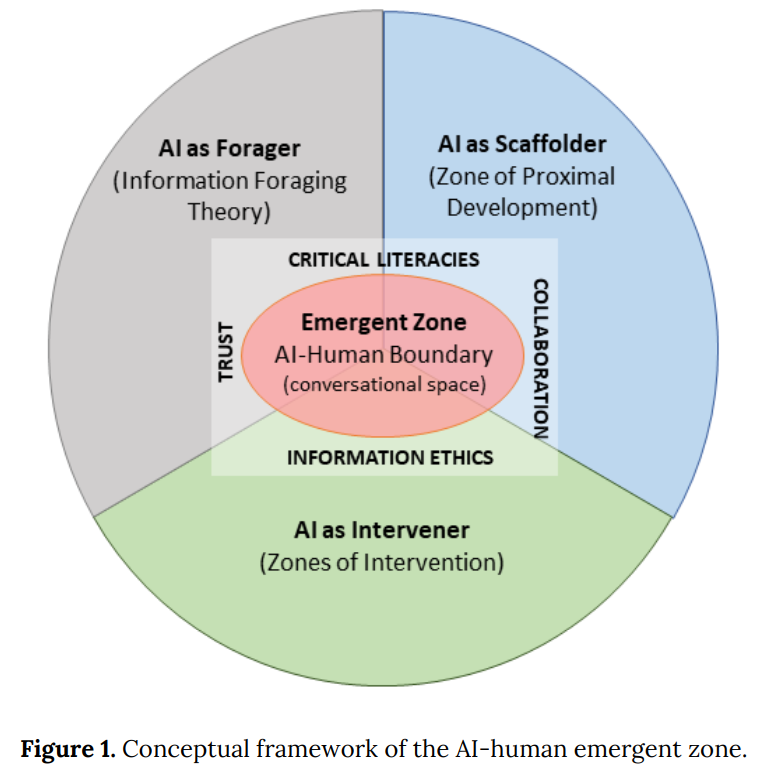
Ultimately, the theoretical background, AI roles, critical literacies, and ethical considerations form a coherent conceptual framework (see Figure 1) for understanding AI-mediated information work.
Conclusion
This paper conceptualised the Emergent Zone as a conceptual framework (see Figure 1) for understanding human-AI interaction in CIR systems and practices. Building on Information Foraging Theory, ZPD, and Zones of Intervention, it positions AI as a forager, scaffolder, and intervener across various contexts. The framework foregrounds critical epistemic and ethical stakes (i.e., credibility, agency, and trust) while remaining attentive to cultural and infrastructural differences. This AI-human conversational space is grounded in information ethics, trust, collaboration and integrated critical literacies (e.g., prompt literacy, interpretive vigilance, algorithmic and data literacy, and ethical literacy), creating an Emergent AI-Human Zone to enhance learning and extend capabilities
For LIS professionals, this means embedding meta– and critical literacies into curricula, designing ‘librarian-in-the-loop’ services, and co-creating policies with communities. For researchers, it suggests mixed-methods studies of human-AI entanglements and developing evaluative frameworks that prioritise interventions that integrate learning, inclusion, and justice over mere efficiency.
Future work should investigate how Emergent Zone practices differ by language and culture, how provenance signals affect user trust, and pedagogical designs that cultivate sustained critical engagement. Treating the AI-human boundary as an Emergent Zone, LIS can contribute to resilient and ethical knowledge ecosystems that harness AI’s benefits while mitigating harms. The goal is not to master the AI system; instead, to effectively negotiate the new relationships it fosters between humans and machines.
About the Authors
Anika Meyer is a Lecturer and the Programme Coordinator of the BIS Information Science degree in the Department of Information Science at the University of Pretoria, where she is also pursuing her doctoral studies, titled ‘Stakeholder information sharing: a naturalistic case study of agile software development’. Her research interests include information behaviour, knowledge management, guided inquiry, third space, creative spaces, participatory design, agile methodologies, and artificial intelligence literacy and tools. She published her first book in 2021, titled ‘Third Space, Information Sharing, and Participatory Design’, in collaboration with Prof. Preben Hansen and Prof. Ina Fourie. She can be contacted at anika.meyer@up.ac.za.
Marlene Holmner is an Associate Professor in the Department of Information Science, University of Pretoria, South Africa, and the current Head of the Department of Information Science. Marlene serves on the Information Technology for Development Editorial Board and several other journal editorial boards. She is also active in ASIS&T, serving as an officer in 2021-2023 and a Steering Committee member of African Center of Excellence in Information Ethics. Marlene publishes primarily in the areas of information ethics, information communication for development, and ICT in education. She can be contacted at marlene.holmner@up.ac.za.
Theo J.D. Bothma is Professor Emeritus/contract professor in the Department of Information Science at the University of Pretoria, South Africa. He is the former Head of Department and Chairperson of the School of Information Technology (until his retirement at the end of June 2016). His current research focuses primarily on aspects of information literacy, e-lexicography and digital humanities. He is a member of ASIS&T, a Steering Committee member of African Center of Excellence in Information Ethics, and joint Editor-in-Chief of Libri. He can be contacted at theo.bothma@up.ac.za.
___________________________